How to Build an Election Rumor: A Mad Libs Guide to Manufacturing a Conspiracy Theory
Election rumors run on a template. How the "color revolution" theory and DataRepublican's "Democracy Files" fit it, plus a Mad Libs game to write your own.
Why the same stories come back every election, and a game that lets you write your own.
Over on X this week, one of the top trends has been a theory that “the left” is organizing a “color revolution” to disrupt the 2026 election. What color? Unclear. But according to the extremely online right it is absolutely going to happen—just as it was going to happen in 2024, 2022, and 2020.
I’m going to explain the theory, but more importantly, we’ll play a game that shows how rumors like this get constructed.
A “color revolution” refers to mass protest movements following disputed elections, when protestors turn out in the streets wearing a shared color or symbol. Think Ukraine’s Orange Revolution, or Georgia’s Rose Revolution. The term has become a conspiratorial shorthand, popularized by Russia and China, for dismissing popular uprisings as CIA-orchestrated regime-change operations precipitated by secret instigators, trained activists, and shadowy funders.
This year’s American version comes to us in the form of The Democracy Files, a series of decontextualized screenshots and video clips posted by Jennica Pounds, aka DataRepublican, herself a secret fed until recently. She claims that they show former USAID employees preparing a color revolution for the upcoming midterms. Similar warnings circulated in 2024; Jack Posobiec was on the case then. In 2020 Darren Beattie, now a senior Trump appointee, concocted the frame: Black Lives Matter protests, mail-in ballots, and Democratic officials were supposedly fomenting that cycle’s color revolution. He went on Tucker Carlson; his conspiracy theory went viral.
“Hmm…,” you may be wondering, “…what color were all of those revolutions?”
Well, it turns out that not one of them materialized. In 2022 and 2024, Republicans gained power in the House and then the White House…but there were no mass left-wing street uprisings. (The people who stormed the Capitol to interrupt election certification on January 6, 2021 were not the secret left-wing army the theories described.)
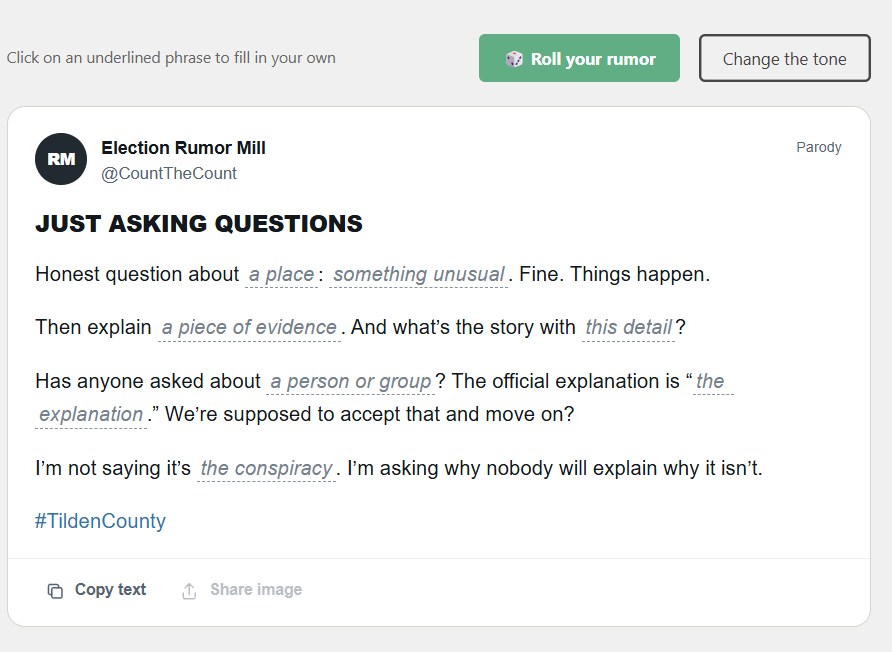
So why does this zombie theory keep returning? For the same reason claims about suitcases of ballots, rigged machines, and mysterious white vans do: the story is largely written, and each election supplies new details. Think of what’s happening like a game you’ve probably played before: Mad Libs. And you’re going to get to play again.
In a Mad Lib, someone asks you for a noun, an occupation, or an object without showing you the story. You volunteer “toaster” and soon discover that your toaster is at the center of an elaborate criminal conspiracy. You provided a few nouns and verbs, but the story was already written; whether it makes sense or not is a different issue.
This same structure underpins election conspiracy theories. The specifics change, but the syntax does not. Whatever details you insert, the post still sounds suspicious—because suspicion and insinuation were built into the narrative before any event occurred. If you follow partisan political influencers during election seasons, you’ve heard these scripts before.
THE GRAMMAR OF A RUMOR
The trick to Mad Libs is that the story has already been written. Players supply the missing words, and each combination can produce wildly different results from an unchanged grammatical structure. The election rumor mill produces endless new allegations from a remarkably stable narrative structure.
I’ve written for years about the recurring tropes of election rumors: satellites, Sharpies, suitcases at polling places, dead voters. Researchers at the University of Washington have catalogued them extensively, even making an election-rumor bingo game. These are the characters and props…but there are also recurring stories that they get slotted into.
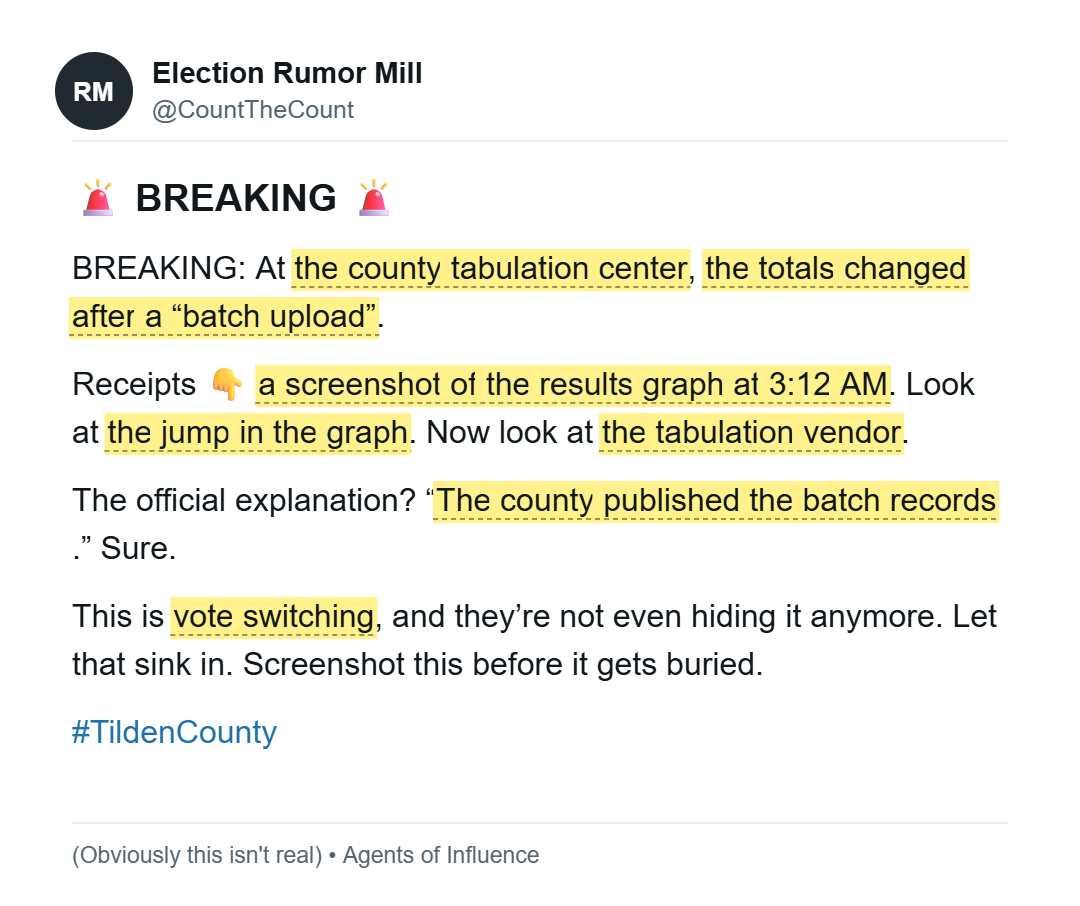
In Mad Libs, the blanks fill grammatical roles: noun, verb, adjective. In election rumors, there are recurring narrative roles: a Suspicious Thing, a Hidden Mechanism, a Villain, a “Receipt,” and a larger plot.
Consider a white van arriving outside a counting center late at night. That’s an observation. But if you’re looking to find an anomaly or hidden mechanism to explain why your candidate lost, it can be easily made suspicious: Why was the van there? What was inside? Perhaps it was delivering fake ballots on the orders of corrupt election officials, as part of a scheme to steal the election. A photograph of the van becomes the “receipt,” even though it establishes none of the rest of the story. An ordinary event has been turned into evidence of a secret operation. The official explanation, if one has been communicated, is often waved away: “Sure. Of course they’d say that.”
The same process is at work in DataRepublican’s Democracy Files. The nouns are real: a former USAID official, a tabletop exercise about a potential constitutional crisis, an org chart. But she supplies the verbs: preparing, coordinating, plotting. The accusation is largely made through insinuation, so the documents can be authentic even though the larger story constructed around them is not.
The story DataRepublican is currently slotting everything into—the “domestic color revolution”—is well-known to her audience. Conspiracy Mad Libs draw on years of deep lore; the term may be new to you, but the online MAGA right is very familiar with it. For DataRepublican’s extremely online right-wing audience, nonprofits are presumed to be fronts, former government employees are operatives, and two people appearing in the same email are colluding. Specific people, institutions, and processes have become recurring characters in a conspiratorial cinematic universe; their appearance in a new allegation immediately conveys to the audience what sort of plot they’re looking at. They hear “USAID” and associate it with a regime change front org dedicated to installing woke globalists and keeping the populist right down.
The Files brand is also highly familiar. We’ve had the Twitter Files, Facebook Files, Fauci Files, GEC Files, and now the Democracy Files. There are always numbered threads, highlighted screenshots, dramatic claims, and promises that the next installment will connect the dots. (Use the “Change the tone” button in the Mad Libs generator to convert any conspiracy theory into Part One of its own Files.)
Finally, the grammar of the story provides a way for all of these pieces to fit together. The lore supplies the context and history that make the story immediately familiar to its audience. A new incident provides a fresh hook. Each retelling reinforces the plot, and makes it seem more real.
Familiarity, novelty, repetition. That’s what keeps the election rumor mill turning.
For now, the “color revolution” claim will continue to circulate. It can cover everything! Strong Dem results in the midterms will mean the left didn’t need to riot because their election rigging worked. If Dems do poorly but there are no protests, well, DataRepublican and friends exposed the conspiracy just in time. If there are some protests somewhere, it’ll be proof that the color revolution is commencing. A theory that accommodates every outcome can’t be disproven, which is a large part of its appeal. “Color revolution” also has a cloak-and-dagger spy movie intrigue to it. So, it will almost certainly make the rounds again in 2028 as well.
As you play the Mad Libs game, know that real election misconduct does occasionally happen, and it deserves investigation. But a one-off or odd occurrence isn’t proof of an intentional secret plot. A collection of authentic documents isn’t proof of every theory that someone constructs around them. Establishing what actually happened, and whether the evidence supports the accusation, requires considerably more work than just generating a rumor.
So the next time someone on X announces they’ve uncovered a plot to steal an election, see how many of the blanks you can fill in while you wait for them to show you the evidence.
For now, go play the game.