I Was Falsely Accused of "Censorship" in The Free Press. Then Their Editors Censored The Truth.
I prefer to keep drama off main in this newsletter, so I would rather not have to publish a post like this. But one of the things I've been meaning to write about is the way that partisan media ecosystems protect their own. This is a case study.
Two weeks ago, The Free Press published an essay by Tablet Magazine editor Jacob Siegel alleging that I’d gotten a review of his book in The Baffler censored. He promoted it aggressively on X, claiming “a figure connected to the US government pressures a publication to remove its review of my book,” and that it was “censored the next day... apparently at the behest of Renee Diresta.” Sympathetic influencers piled on.
The claim was false. I sent The Free Press the email exchange showing that I had asked for a correction, and the reviewer said he had asked for the review to be taken down.
The false accusations and wild innuendo ran under the headline: “I Wrote a Book About Censorship. Then People Tried to Censor It.“ The Free Press has seen the emails that destroy the premise of the piece. But they’ve done nothing to acknowledge their existence to their readers, or to update the piece with so much as an Editor’s Note.
How We Got Here
Siegel’s book, The Information State, is the Twitter Files crossed with a Glenn Beck chalkboard: a string of insinuations combined with just enough political theory to dress up paranoia as scholarship. CIA Renee is a character in the book, leading “the largest public-private social media monitoring and censorship initiative in existence” behalf of the Biden Regime that totally ran the government in 2020.
Some reviewers took Siegel’s innuendo at face value. They wrote Twitter Files lies about how the Election Integrity Partnership plotted to censor 22 million tweets, or the Virality Project ‘demanded the censorship of true stories of vaccine side effects’ as fact in their reviews. It’s not their fault they were deceived, but I asked for corrections because these lies are indefensible at this point, and I want these outlets to acknowledge reality to their readers. The Free Beacon promptly corrected and offered me space to respond. The Brownstone Institute did nothing. The Baffler pulled their review – at the reviewer’s request, per his email. And Siegel lost his mind.
The Free Press gave Siegel ~2,000 words to turn a correction request into a persecution narrative. Their newsletter promoted it to a million readers, asking, “Is the age of censorship really over?”, and claiming that Siegel’s book “was subjected to the very dynamic he describes in its pages” when a review was “purged” from The Baffler “after a person mentioned in the text requested a correction.”
The “investigation” underlying this article consisted of Jacob Siegel sending me a list of demanding questions with 102 minutes to respond. He requested my private correspondence with The Baffler, which was inappropriate so I refused to indulge him. Siegel then wrote that I “didn’t deny” asking for the review to be pulled. The story ran hours later.

I tracked down an editor at The Free Press and told her the story was nonsense. I asked why it hadn’t been fact-checked, and was told that Siegel’s email had been the fact-check. “Yeah, we were back and forth on the whole comment request,” the editor said a bit sheepishly, when I expressed amazement. I denied the claim by phone and email, then forwarded my actual correction request as proof.
She offered me a letter-to-the-editor to respond; I said I thought the accusations deserved more than a few paragraphs stuck in the far reaches of their site, and was told that they would promote it. But, she warned: it would be edited and fact-checked.
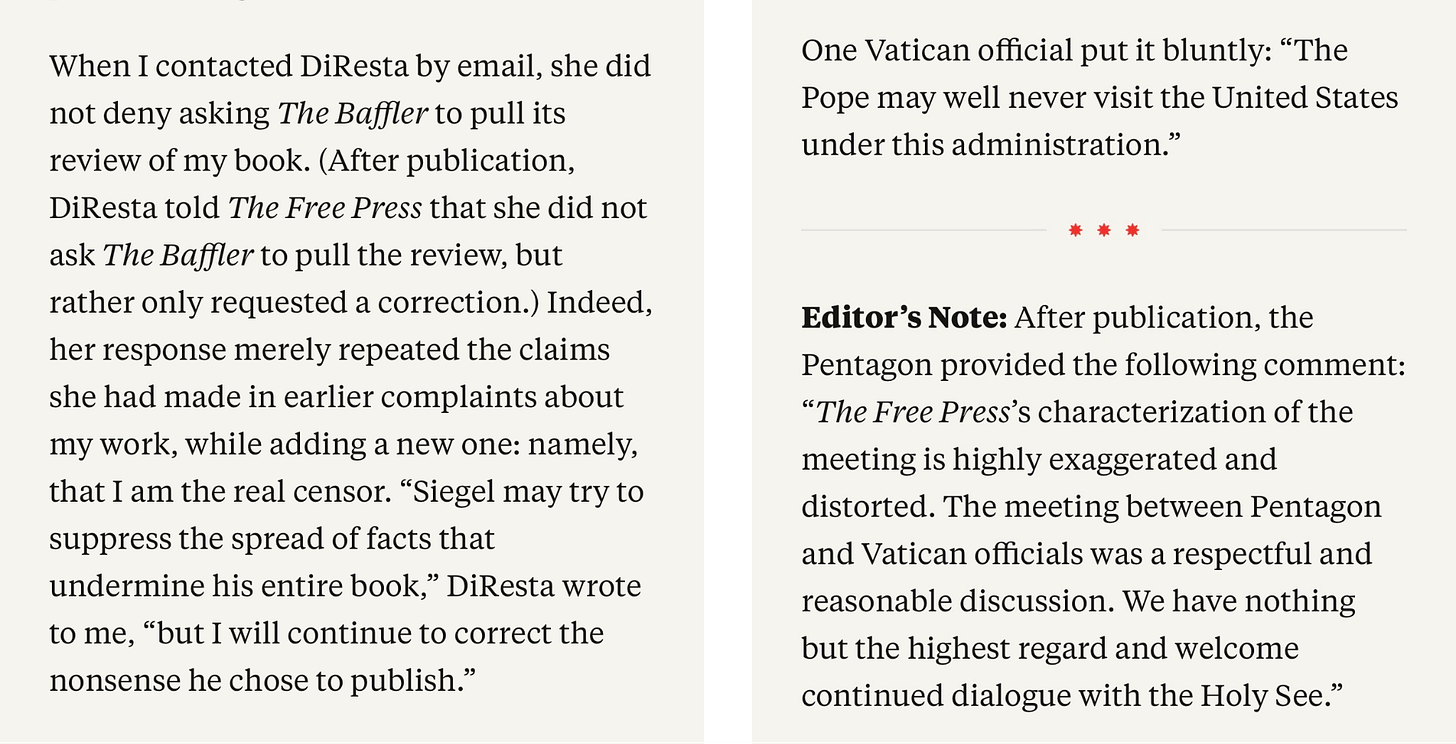
Nearly three days later they inserted a parenthetical sentence with my denial into the body of Siegel’s prose, below the paywall. No formal editor’s note. As a contrast, here’s what an Editor’s Note on a different disputed story from the same timeframe looks like.
On April 5, I additionally sent them the reviewer’s email saying he had requested the takedown. Still, no editor’s note.
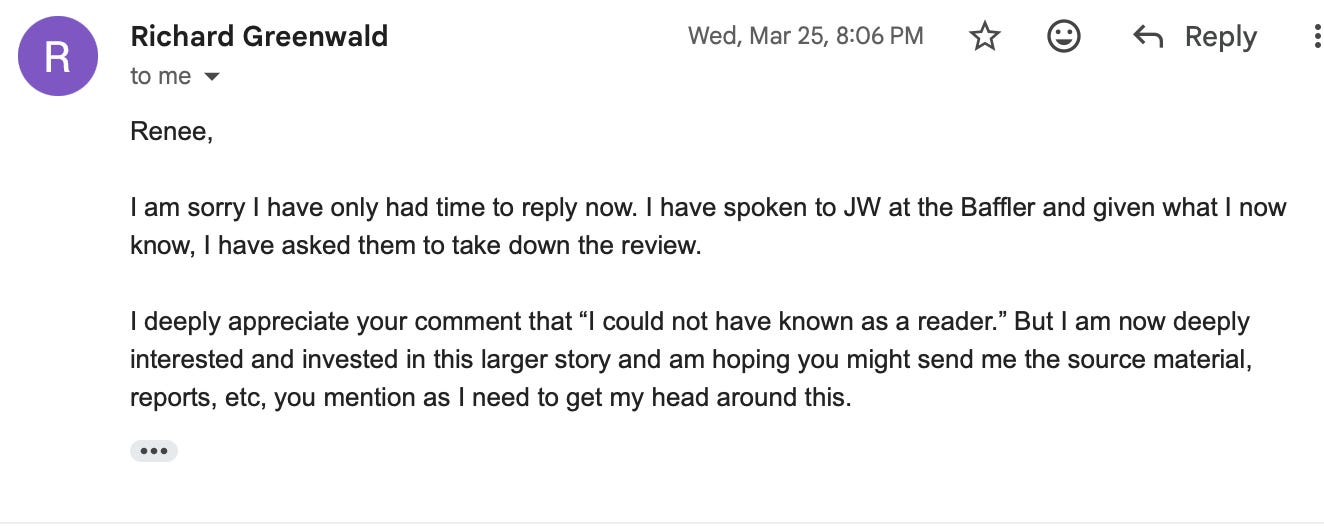
I didn’t publish this exculpatory email immediately because I didn’t want to drag the reviewer into the online pile-on that TFP story predictably generated. He didn’t ask to become a character in Siegel’s self-mythologizing censorship melodrama.
The “Very Worthy Letter”
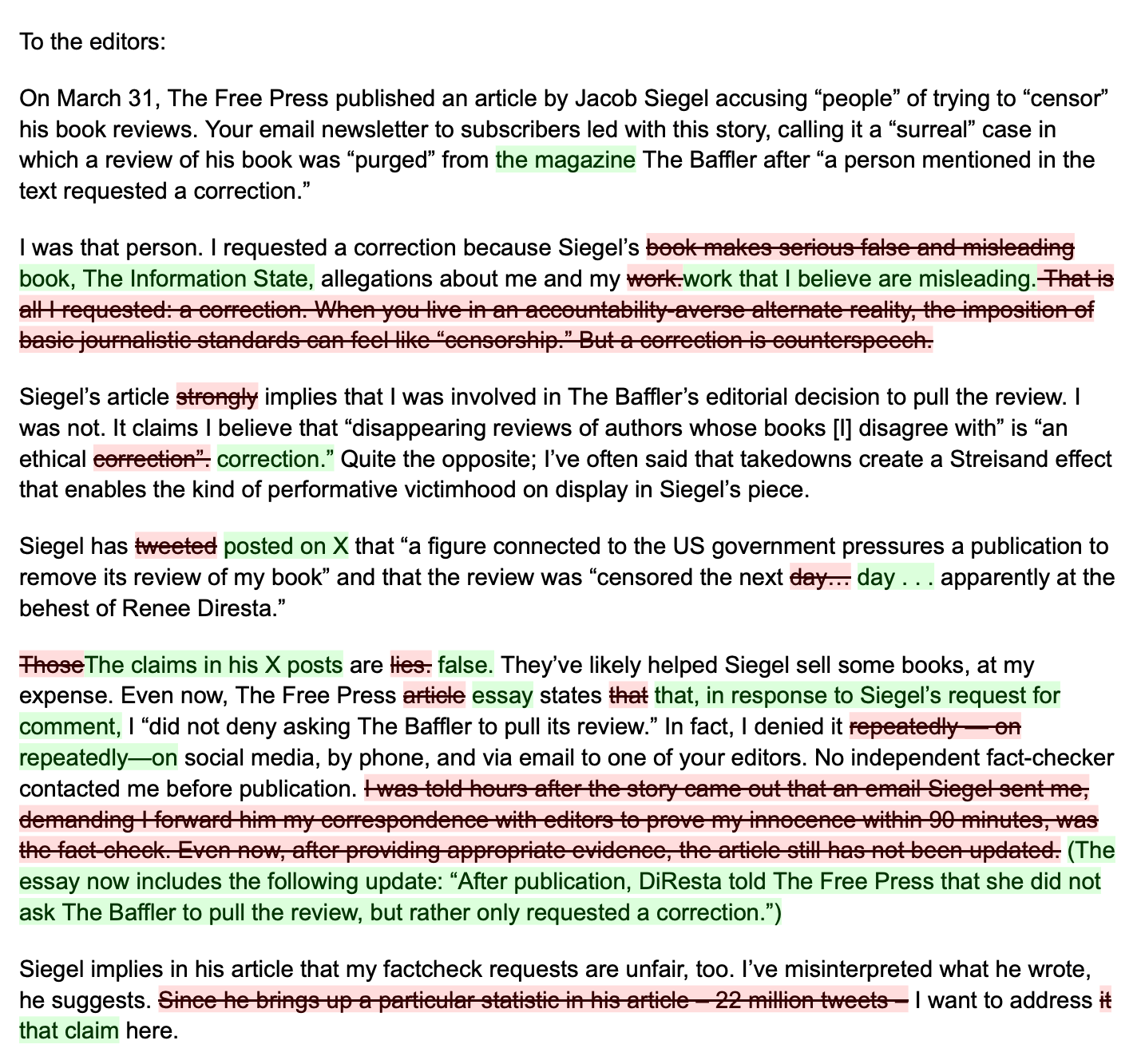
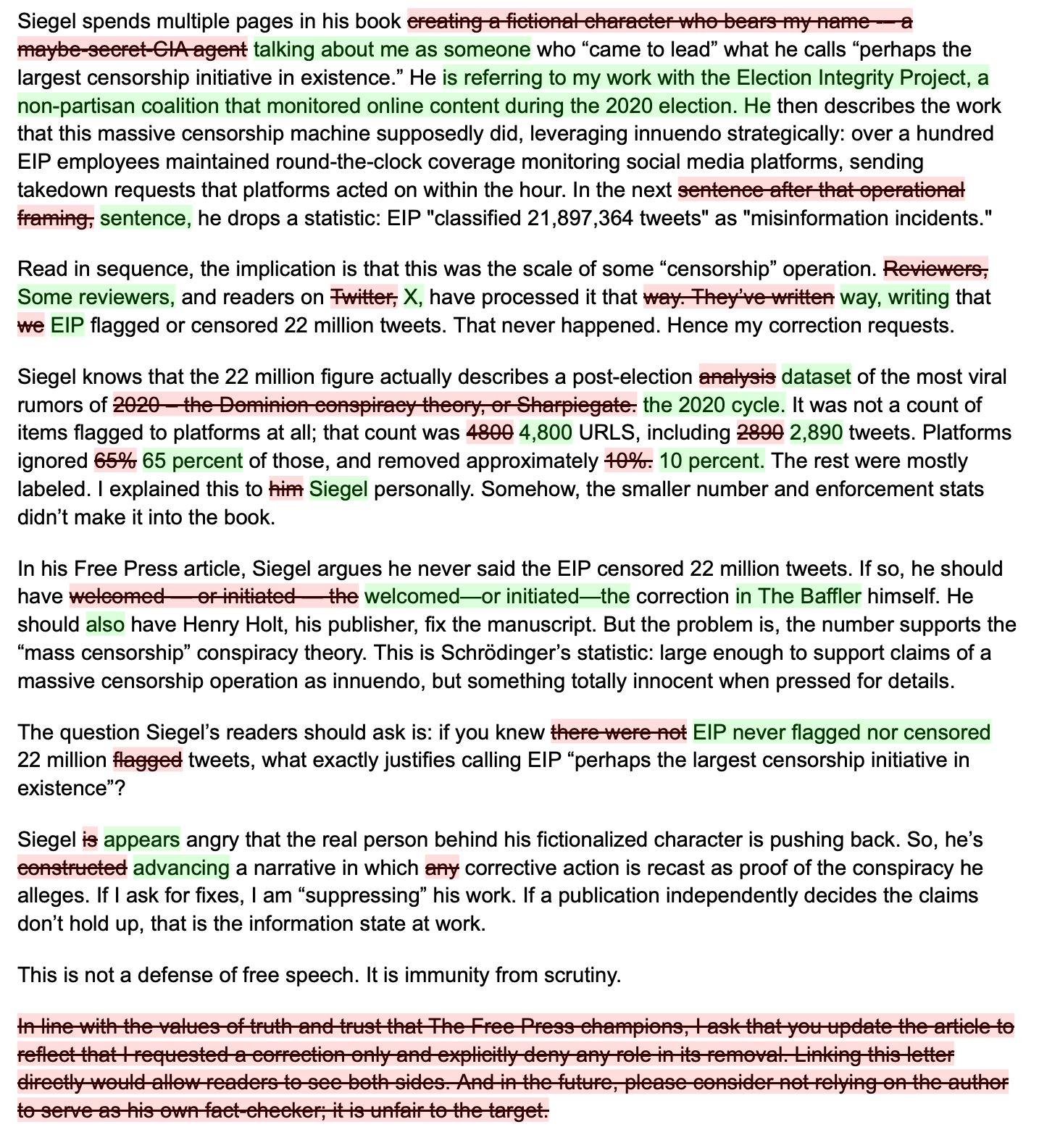
I drafted a Letter to the Editor laying out the facts: I had requested a correction related to demonstrably false claims about our work — not a takedown. A correction request is counterspeech, not “censorship.” I asked The Free Press to update the article, and to perhaps not use the accuser as the fact-checker in the future.
What came back was not an edit. It was a containment effort.
Where I had stated facts directly, The Free Press inserted distance. Declarative statements received “I believe” qualifiers. Siegel was allowed to write that I was “either wrong or deliberately misrepresenting” his work. He didn’t have to “believe” that I was “misled.” He could speculate about what I thought, what I did, and what shadowy ecosystem I supposedly represented. But when I responded, suddenly everything had to be hedged.
Adjectives disappeared: Siegel hadn’t sent me a demanding email requesting my private communications – just “an email.”
References to The Free Press’ responsibility — including their lack of acknowledgement of the reviewer’s email and how it blew up the theory — were pared back or removed.
But this was not simply legal CYA—opinion sentences, like my “belief” that correction requests are counterspeech—not censorship—were cut.
On April 9, after two rounds of this, I wrote to the editor: “I see more adjectives removed, declarative framing sentences cut, and a lot of ‘I believes’ inserted into extremely defensible matters of fact. I’m trying one final time here.”
What came back was remarkable. They had sent me “a very worthy letter to the editor” that gave me “significant latitude to respond to the piece,” I was told.
I asked, directly: “But why aren’t you updating the piece with a note clearly reflecting that the man withdrew his own review? Is it because it undermines the headline’s premise, ‘Then People Tried to Censor It’?”
They ignored the question.
My managed letter went up on Friday—without clear attribution as a right-to-reply, midway down the page as just a link that says “Letter to the editor”. It could have come from anyone. They sent it out as the bottom item in the Monday newsletter…no editorial framing.
A Free Press for Free People
The Free Press has every right to edit my letter and exercise editorial discretion, of course; I chose the word “censorship” in the headline to mock my accuser’s commitment to rendering that term meaningless, and TFP’s willingness to toss it around just as baselessly. When I pushed back one final time and said some things were non-negotiable, I did get them into print. But I wrote this post because TFP protected an ideologically aligned writer while slow-walking, hedging, and ultimately ignoring exculpatory evidence.
Here is The Free Press’s values page:
“We seek and report the truth. We tell it plainly when we uncover it, even when it’s politically inconvenient.”
“We assume good faith. We treat each other and our sources with the utmost respect.”
“We are adults, and we treat our readers like adults, too. We encourage each other to think for ourselves and change our minds when we encounter new information.”
And here is the timeline: On April 1, a Free Press editor read evidence that the premise of Siegel’s story was wrong. On April 5, I sent the reviewer’s email saying he himself asked for the takedown. On April 9, I asked the editor directly why the article still hadn’t been updated with this information and they ignored the question. As of April 14, the article still shows no indication that the smear was completely baseless.
Consider how TFP circled the wagons to protect their narrative, then decide for yourself what those values are actually worth.