Trump is going to lie to you tonight. An old guide to propaganda shows how to spot the red flags.
Trump is expected to revive his false claim that the 2020 election was stolen, using selectively declassified intelligence as “receipts.” Here’s how to spot the tricks used to sell that story.
Trump is expected to revive his false claim that the 2020 election was stolen, using selectively declassified intelligence as “receipts.” Here’s how to spot the tricks used to sell that story.
At 9 p.m. today, President Trump will address the nation to deliver what he has hyped as "really, really big news." Early reporting suggests that the big news will involve “newly declassified intelligence” about supposed voting-machine vulnerabilities, foreign interference in the 2020 election, voter rolls, illegal voters, and a deep state conspiracy to suppress the proof of all of this.
We do not yet know exactly what documents Trump will release or every allegation he will make. But we know the narrative he has spent nearly six years trying to establish: The 2020 election was stolen from him, and officials who said otherwise were corrupt, incompetent or part of the plot. We have also seen Tulsi Gabbard repeatedly play a declassification theater game, in which she dumps a tranche of documents while making a sensational claim, but the documents don’t support the claim.
Within minutes of the speech, however, sympathetic media and influencers will circulate clips, screenshots and excerpts as proof that Trump has finally produced the “receipts.” Assessing whether the documents actually support those claims will take fact-checkers, journalists, and analysts hours, perhaps days. By then, the headlines, chyrons, TikTok cuts and AI-generated summaries will already have reached millions of people.
That speed gap is part of the strategy. Refuting bullshit takes far more energy than producing it, so the debunk will land some time after the allegation has already gone viral.
Rather than trying to adjudicate every claim immediately, viewers can ask a simpler question in real time: What techniques are being used to sell this story?
There is a nearly 90-year-old guide to help with that exact question.
An old field guide to propaganda
In 1937, amid the rise of radio demagogues such as Father Charles Coughlin, journalist and educator Clyde Miller helped establish the Institute for Propaganda Analysis. Coughlin reached an enormous national audience with conspiracy theories and defenses of fascism. The institute used his speeches as a principal case study.
The institute’s founders believed that silencing demagogues, answering them with counterpropaganda, or producing an endless succession of fact-checks were all inadequate responses. Their alternative was to teach ordinary people how persuasive rhetoric worked—how to spot red flags, which could be applied regardless of speaker or moment.
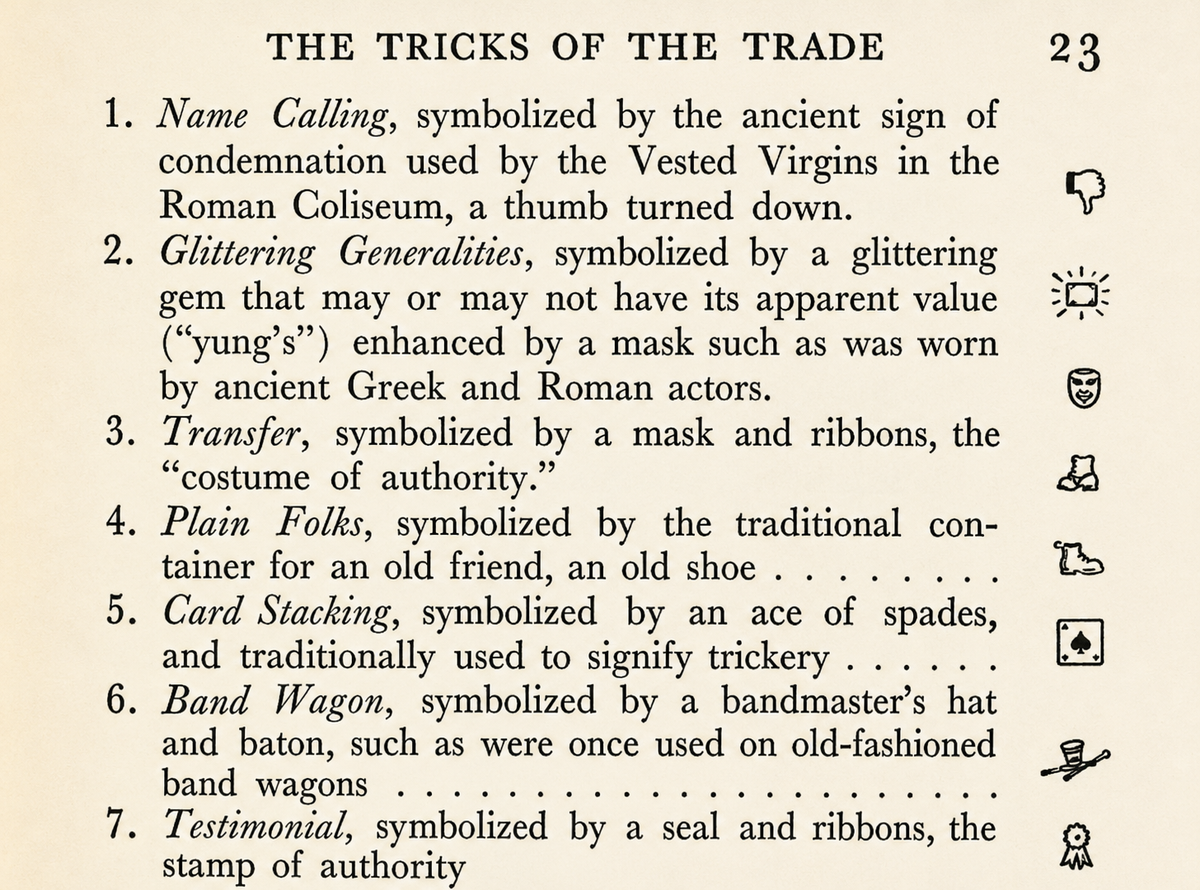
The IPA identified seven recurring “tricks of the trade” and assigned each a small symbol—a little proto-emoji. The categories were imperfect, and persuasive messages frequently used several at once. But they offered people a practical vocabulary for recognizing what a speaker was doing to them.
The seven tricks remain directly relevant tonight.
👎 Name-calling
Name-calling attaches a hostile label to a person, institution or idea so that the audience dismisses it without considering the evidence.
It replaces evaluation with association. Instead of asking whether a claim is true, the listener is invited to decide whether its alleged source is a “traitor,” a “criminal,” an “elite,” a member of the “deep state” or an “enemy of the people.”
Trump has repeated the phrase “stolen election” so often that it now functions in much the same way. He does not, and cannot, describe a demonstrated mechanism by which the result was changed. Tonight, I personally anticipate yet more disjoint allegations with no evidence of any votes changed or suppressed. Nonetheless, he has repeatedly told his base what emotional category the election belongs in.
Name-calling also frames the subsequent debate. Anyone who challenges the allegation begins under the shadow of the label already assigned to them: corrupt, crooked, complicit or part of the conspiracy.
Watch for: labels applied to election officials, intelligence analysts, journalists, judges or political opponents in place of a specific account of what they did.
Ask yourself: What evidence would remain if the label on the speaker disappeared?
💎 Glittering generalities
A glittering generality wraps a political project in a vague, emotionally attractive term: “freedom,” “transparency,” “security,” “integrity,” “accountability.”
These words carry powerful positive associations but are sufficiently abstract to serve almost any objective; the devil is in the details. When they are not provided, the audience supplies the meaning. The speaker avoids making a concrete assertion that can be tested.
“Election integrity,” for example, can mean improving security, auditing results or ensuring eligible citizens can vote. It can also be used to justify federal investigations of local election workers, aggressive voter-roll purges or attempts to centralize authority over elections.
“Transparency” can mean releasing information that helps the public understand what happened. It can also mean publishing a highly selective collection of documents, stripped of the surrounding context needed to interpret them.
Watch for: Watch for: noble-sounding words — 'protect election integrity,' 'transparency' — offered as responses to non-events, or with no specifics at all.
Ask yourself: What specific allegation or government action is this attractive word being used to justify?
🎭 Transfer
Transfer borrows the authority, prestige or emotional force of one thing and assigns it to something else.
Declassification theater depends heavily on transfer. A presidential podium, an intelligence-agency seal and a stack of documents marked “declassified” create an atmosphere of revelation. They make the underlying allegations feel as if they carry the full authority of the presidency and the intelligence community.
But classification is a designation about whether information may be disclosed. Declassification does not certify that a document is accurate, complete, representative or supportive of the claim being made about it.
Tulsi Gabbard used this playbook in her final act as director of national intelligence, releasing hundreds of pages about Anthony Fauci under the explosive headline “Fauci Funded Wuhan Lab Research That Sparked COVID.” The documents did not establish that claim. She ran the same play to allege a treasonous coup by Obama-era officials — a sensational headline out front, documents that don't carry it. In all cases, the official title, agency seal and sheer volume of paper helped make the allegation look like an intelligence finding rather than a political interpretation imposed on a selective release.
Tonight, the setting will do similar work. Trump will not appear merely as a man repeating a claim he has made for years. He will appear as the sitting president, surrounded by officials and invoking the secret knowledge of the national-security state.
Watch for: official seals, classified markings, imposing stacks of paper and references to secret knowledge being used as substitutes for a clear evidentiary chain. “Declassified intelligence” can show that Iran, Russia, and China ran influence operations targeting US elections – something we have long known. It likely will not show any evidence of impact, or evidence that it affected any outcome. The details matter.
Ask yourself: What does the document itself establish—and what authority is the staging merely inviting me to infer?
🏅 Testimonial
A testimonial enlists a respected, famous or seemingly authoritative person to validate a message.
The person’s endorsement may reduce scrutiny of the underlying evidence. Their credential may be real but irrelevant to the question at hand; an intelligence title, government position or large following does not automatically make someone an election-security expert. A “whistleblower” can file a report through a specific channel that earns them that title, but may not actually have deep knowledge of very much.
Testimonials now move through an entire political-media system. Officials make the allegation. Selected journalists and influencers—sometimes pre-briefed—repeat it. Commentators cite the officials. Social-media users cite the commentators. AI systems summarize the apparent consensus. Each layer points to the others as confirmation. In reality, it may well just be circular sourcing of a very weak claim.
The technique can also run in reverse. A designated villain is established, and then even ordinary statements begin to look sinister because the audience has already been told that the speaker is corrupt. This is how testimonial and name-calling reinforce each other.
Watch for: officials and influencers vouching for conclusions without explaining how the evidence establishes them.
Ask yourself: Does this person have relevant expertise—and have they shown their work?
🥾 Plain folks
Plain folks is the powerful figure presenting himself as an ordinary citizen: one of us, speaking for us, fighting people who look down on us.
The technique collapses the distance between the speaker and the audience. A president directing the federal government becomes simply a concerned voter asking questions. An intelligence chief with the power to select and declassify documents postures as a mere citizen demanding answers from unaccountable bureaucrats.
Gabbard addressed her releases to “taxpayers,” “millions of fellow Americans” and “the American people”—the ordinary citizens supposedly betrayed by a hidden conspiracy. Trump similarly casts himself as the representative of regular voters whose concerns were mocked by elites.
This framing conceals the actual distribution of power. The person claiming to stand outside the system may control the agencies conducting the investigation, the officials deciding what to release and the podium from which the allegations are announced.
Watch for: extremely powerful people presenting a political agenda as if they are mere proxies for “ordinary Americans.”
Ask yourself: Who actually has institutional power in this situation, and how is that power being used?
♠️ Card-stacking
Card-stacking selects the information that supports a conclusion and hides, minimizes or excludes the information that complicates it.
The selected facts may be authentic. But propaganda narratives take a grain of truth and spin a whole story from it.
This is the central mechanism of declassification theater. A government can search through years of emails, intelligence reports and internal disagreements, extract a handful of suggestive lines, release them without the full record and announce that the resulting pile proves a sweeping accusation. As the saying goes, “If you give me six lines written by the hand of the most honest of men, I will find something in them which will hang him.”
Trump may present evidence that foreign actors sought voter data, explored vulnerabilities, conducted influence operations or possessed the capability to target election systems. Such evidence does exist – and has been extensively investigated and covered. Its existence does not prove that any foreign actor altered votes or changed the result of the 2020 election.
These distinctions are crucial:
Evidence of a vulnerability is not evidence that it was exploited.
Evidence of a foreign effort to interfere or influence is not evidence of impact.
Evidence that analysts disagreed is not evidence of a cover-up.
Evidence of politicization inside an agency is not evidence that the election was rigged.
The intelligence community’s declassified March 2021 assessment said it had no indication that any foreign actor altered any technical aspect of the voting process, including voter registration, ballot casting, tabulation or the reporting of results.
Newly declassified documents could reveal that analysts debated the degree of foreign influence, or which candidate an influence effort favored. They could reveal that politicization crept into internal processes. Those would be important issues to address; in fact, they’ve already been investigated and covered. These claims would not, by themselves, establish Trump’s separate claim that the election was rigged or stolen.
For that claim, the evidence must show that votes—or the election’s outcome—were actually changed.
Watch for: authentic fragments treated as proof of a much larger conclusion or conspiracy, especially when contrary assessments and contextual documents are absent.
Ask yourself: What evidence was not included, and how large is the logical gap between the document and the headline?
🥁 Bandwagon
Bandwagon tells you that everyone already agrees, and therefore you should agree too.
The technique exploits the desire to belong and the fear of being isolated. On social media, visible metrics—likes, reposts, views, trending labels—make the appearance of consensus quantifiable.
The political pressure can be even more direct. MAGA officials, influencers and media figures understand that contradicting Trump can bring denunciation, audience loss or exclusion from the faction. There will therefore be intense pressure to describe whatever appears tonight as a bombshell, even before anyone has had time to read the supporting material.
The resulting chorus will then become evidence of its own. So many people are saying it. Everyone knows. The story is everywhere. Why won’t the mainstream media cover it?
This is how repetition creates a majority illusion. A coordinated or highly disciplined faction can look like the public as a whole.
Watch for: claims that the truth is finally obvious, that “everyone knows,” or that the volume of online agreement itself validates the allegation.
Ask yourself: Am I seeing independent confirmation—or many people rapidly repeating the same source?
Declassification theater combines the tricks
Declassification theater is a modern political performance that combines several of these well-established tricks.
The documents provide transfer, borrowing the authority of intelligence agencies. Officials and influencers provide testimonials. The release is card-stacked, presenting selected material without the full context. Critics are neutralized through name-calling. “Transparency” and “election integrity” serve as glittering generalities. The president presents himself as the champion of plain folks. And the faction rapidly forms a bandwagon around the announced conclusion.
The speed gap between the release, and the independent assessment of potentially thousands of pages, insulates the entire performance. The claim can be communicated in one sentence; explaining why the underlying documents do not support it may require hours of work and pages of analysis.
That is why claim-by-claim rebuttal, though necessary, is whack-a-mole by design. It leaves the critic permanently one step behind.
Point out the pattern
The 2020 election was extensively audited, recounted and litigated. Trump and his allies failed to produce evidence that fraud or foreign manipulation changed its result. The intelligence community found foreign influence efforts and even threats—these are table stakes now—but no indication that a foreign actor altered registration, ballot casting, vote tabulation or reported results.
There will be point-by-point responses to whatever Trump says tonight. I expect to publish one at Lawfare. But the more durable skill is recognizing the recurring structure of the performance.
The Institute for Propaganda Analysis believed that citizens could be taught to recognize those techniques for themselves. Its framework does not tell you whether a particular document is authentic or whether a particular official acted improperly. Sometimes there are, indeed, revelations in new documents. But the IPA framework tells you when rhetoric and staging are being used to push you across the gap between what the evidence shows and what the speaker wants you to believe.
So watch the speech tonight. Be aware of these rhetorical sleights-of-hand, and what they are intended to do.
Once you begin noticing the tricks, they become difficult to miss.