When Matt Taibbi Met Mike Benz
To mark the paperback of Invisible Rulers, I’m releasing audio from a Twitter Space in which Matt Taibbi meets then-unknown political operative named Mike Benz. It is the origin story of the “censorship industrial complex”.
The paperback of Invisible Rulers is out today, with a brand new chapter about how powerful elites in government now spin rumors into reality, justifying power grabs, dismantling agencies, and gutting budgets. You can find it on Amazon here, or independent/other bookstores here.
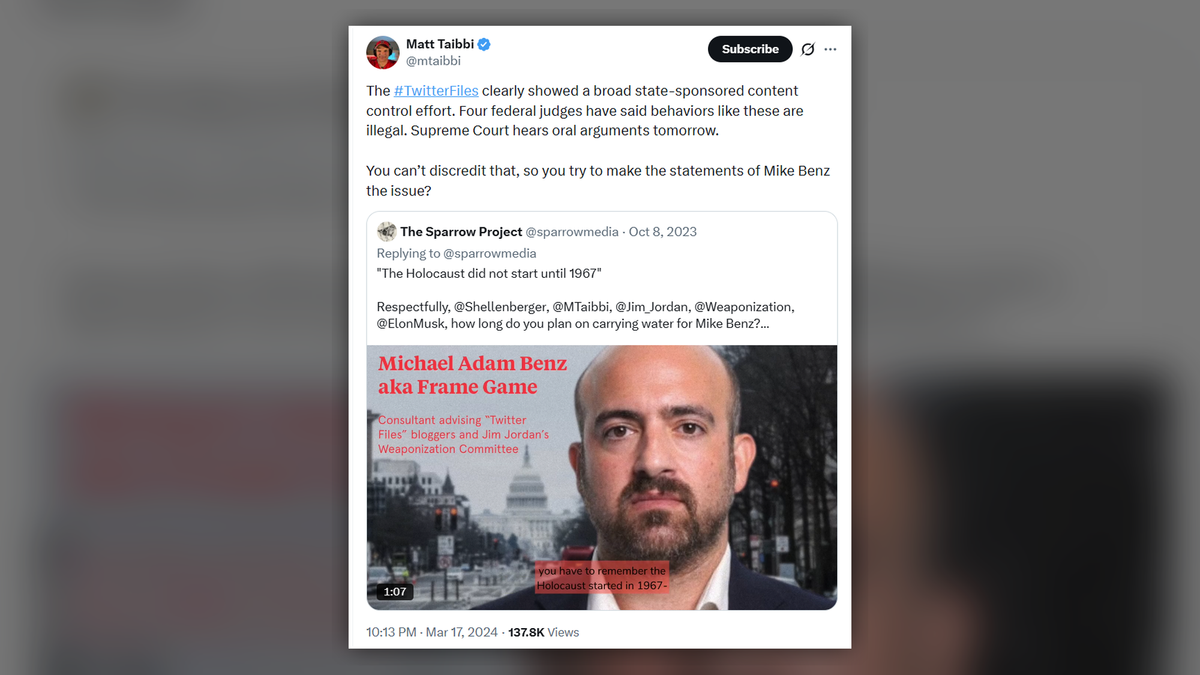
To mark the new edition, I’m releasing audio and a transcript from a Twitter Space in which journalist Matt Taibbi meets a then-unknown political operative named Mike Benz. It is the origin story of the “censorship industrial complex”: a lie, told by a manipulative man and laundered by a famous one, becomes the evidentiary basis for lawsuits, and investigations. Downstream of this event is the dismantling of several federal agencies, including one that delivered lifesaving aid to children.
“All of the missing pieces”
It was March 2, 2023. Matt Taibbi had just published a Twitter Files thread speculating about the State Department Global Engagement Center’s “state-sponsored blacklists” – lists of accounts that GEC suspected were foreign influence efforts, and which it sent over to Twitter. The company overwhelmingly took no action, noting that the suggestions were often unreliable.
Taibbi then linked the premise of flawed lists to other research organizations that also tracked foreign influence. These included the Atlantic Council’s Digital Forensic Research Lab and New Knowledge, where I’d worked for a year on a report examining a data set of actual, unambiguous Russian covert activity that the platforms themselves had turned over to the Senate Intelligence Committee.
“Can we at least stop paying to blacklist ourselves?” Taibbi dramatically asked. He mentioned that Jim Jordan had invited him to testify at the newly-formed Select Subcommittee on the Weaponization of the Federal Government. And he joined a Twitter Space to discuss the thread.
Mike Benz was in that audio chat room. He was a former Trump appointee who’d worked on the effort to prove that the 2020 election was rigged, and then went off to start a blog he called The Foundation for Freedom Online. He interrupted Taibbi’s recounting of his latest allegations with a dramatic opener:
“Matt, it’s worse than that.”
After some fumbling with his microphone, Benz introduced himself. Then he kicked the flattery into high gear:
“I’ve been hoping to talk to you for a long time,” Benz said, “because I believe I have all of the missing pieces of the puzzle that I’ve been watching you search for.”
He praised Taibbi’s “potentially history altering” reporting for a bit, then got to the point: “I hope that maybe I can sort of upload my brain onto yours and see what you do with it.”
“Absolutely,” Taibbi said.
Benz cast himself as an insider who had watched a tyranny take shape. “I was the cyber DAS at State,” he said, “I ran the big tech portfolio at the State Department in 2020 during that time when all of this fusion between big tech and big government was happening.”
“Oh wow,” said Taibbi.
He said Google lobbyists called his desk seeking favors. He had watched the “censorship industry” grow with “total horror and fascination.”
Benz did not mention that he was appointed to this portfolio in November 2020. The Trump administration ended on January 20, 2021. His State Department tenure lasted roughly two months…over the holidays.
Taibbi bit immediately. He told Benz he’d sent him a DM, adding: “I’m very anxious to talk to you in a longer setting if that’s possible.” Benz, he said, “could probably be invaluable” to a huge project he was launching to map the same world.
Benz continued listing his bona fides: there was no close second with his knowledge, he said. He had delivered “eight or nine congressional briefings,” spoken with “four or five senators,” and briefed House and Senate committees. If Taibbi would talk to him privately, Benz said, he could describe “every single individual, institution, the chronology, the pretexts that were used, all of the dirty little tricks that were done each step of the way.”
“I can tell you literally everything,” he said.
“That’s great,” Taibbi replied.
Taibbi had privileged access to Twitter’s internal communications, and an enormous public audience, but the emails he’d highlighted repeatedly showed Twitter ignoring outside requests — not behaving deferentially. The Files writers liberally editorialized around cherrypicked excerpts (and even cut emails in half to change their context) but had yet to produce any evidence of actual mass censorship.
Benz jumped in to offer the missing architecture.
“Wow”
He launched into a lengthy monologue that began—full disclosure—with a discourse on me, and a remarkable version of my biography.
Over approximately three minutes I was elevated from Stanford Internet Observatory director Alex Stamos’s “top lieutenant,” to the “CISA Sherpa on censorship,” to someone “actually giving direction to DHS and to CISA”. I was “essentially a government actor.”
In Benz’s telling, the Election Integrity Partnership had been given “special privileged access” to DHS’s “cybersecurity mission control”, which CISA had converted into a “cyber censorship mission control center.” This, he claimed, gave EIP an “escalation pathway” to every social media company’s content-moderation teams and effectively “deputized” the group with “DHS FBI powers.”
I had supposedly been deputized as well:
“She was deputized as the top lieutenant at EIP to censor not just the 2020 election, and by the way, EIP censored 22 million tweets, okay?”
And with that, Benz gave Taibbi the number that would become one of the key claims of the Twitter Files.
To be clear, the above litany is almost entirely false, misleading, or overstated — including that number. EIP had identified tweets comprising the most viral election rumors of 2020—after the election—and added them up in a table: 22 million. That data set was neither flagged to the company nor censored. Quite the opposite: we analyzed it because the narratives had been so wildly popular.
Taibbi did not ask any questions about the extraordinary claims.
Benz went on, excitedly escalating the “sum damage” of our work to hundreds of millions of suppressed posts. My “lab” had received $3 million from the Biden administration, he said, “right after publishing [our] confession.”
“Wow,” Taibbi said.
“I mean this, this is a scale of censorship the world has never experienced before!” exclaimed Benz. It exceeded China’s Great Firewall by “orders of magnitude.”
Benz rattled off a sweeping mythology of a censorship cabal: Google Jigsaw, the CIA, DHS, DARPA, agencies like CISA created entirely to censor. He presented no evidence of a command structure or any actual suppression, and a lot of what he said was egregiously inflated or simply wrong. But wildly exaggerating things rooted in a tiny grain of truth can be very effective. A collection of analyzed tweets becomes a list of censored tweets. A person who spoke at a government conference becomes a government actor. A grant to study online rumors becomes a $3M payment for censorship.
Benz promised Taibbi that the information he possessed would give him “superpowers.” But he was not merely a potential source trying to persuade a journalist.
He was working a political operation that was already underway.
“The El Dorado”
During his time in the spotlight, Benz described working with groups pursuing FOIAs, lawsuits, and “potentially congressional subpoenas” to obtain supposed “censorship logs” between organizations.
The logs were “the El Dorado,” he said. And the Twitter Files could help him get them.
“You’ve helped me a tremendous amount to be able to educate policymakers on this,” Benz told him. “The Twitter Files—the popularity of them and the accessibility of them—has opened the door…”
Taibbi was due to testify before Jim Jordan’s Weaponization Subcommittee the following week. Benz was explaining, in public, how Taibbi’s reporting could help produce subpoenas to search for the evidence his theory lacked. Benz had “encouraging feedback” that subpoenas were possible; Jim Jordan had already subpoenaed Google, he noted approvingly. He spoke as someone attuned to the committee’s plans, and with an interest in shaping them.
Less than forty-five minutes after entering the conversation as a stranger, Benz had seemingly earned Taibbi’s confidence.
“Mike can correct me on this,” Taibbi said deferentially at one point, while discussing the academics of the supposed censorship apparatus.
Before leaving, he asked Benz to contact him privately. “We definitely have to talk.”
“I used a bunch of it in my testimony”
Days later, Taibbi and Michael Shellenberger testified before Jordan’s committee. Mike Benz sat behind them.
His claims appeared throughout Taibbi and Shellenberger’s testimony. Taibbi referenced being prepped by him. He published a 51-post Twitter thread repeating several of Benz’s false accusations:
“According to the EIP’s own data, it succeeded in getting nearly 22 million tweets labeled in the runup to the 2020 vote,” Taibbi wrote. His next post claimed that EIP had been “seeking elimination of millions of tweets.”
The allegation’s origin—‘something Mike Benz said’—was absent. The statistic was simply presented as if drawn from Twitter’s internal files by investigative journalist Matt Taibbi.
Our document request letter from Jim Jordan arrived the next day. It became a subpoena on April 12, 2023.
Benz fed his theory to Taibbi while encouraging Congress to investigate. Taibbi presented it to Congress as a journalistic finding. Congress then cited Taibbi to justify a hunt for evidence that might validate Benz’s theory.
The documents we produced showed how false the claim was. The ranking member of the subcommittee Taibbi testified before asked him in writing to correct the record. Yet despite repeated debunking, Taibbi never issued a correction. The statistic, after all, is the basis for the “mass censorship” theory; without it, the farce collapses. Taibbi was still doubling down in December 2025. Long before then, the theory had entered subpoenas, congressional records, official House reports, the Murthy v. Missouri litigation, and commentary as key evidence that a mass-censorship regime had been exposed. No one seemed to notice that it was an exercise in circular sourcing.
EIP leadership, meanwhile, gave dozens of hours of testimony and fought two lawsuits; Stanford’s legal costs ran to the seven figures. For over a year, threats and harassment arrived from people who trusted Taibbi and believed the ‘mass censorship’ claims. Stanford wound down the Internet Observatory beginning in the summer of 2024, and subsequently took down its website.
Shellenberger described the Twitter Files writers’ relationship with Benz on Joe Rogan: “Matt Taibbi discovers him,” he said. Benz had been “the head of cyber at the State Department, a senior guy.” He was “super deep into this stuff,” “amazing,” and had documented it “more than anybody.”
“I used a bunch of it in my testimony,” Shellenberger said.
A two-month deputy assistant secretary became ‘the former head of cyber at State’, before an audience of millions. Jacob Siegel and Tablet Magazine would later call him a “former State Department official” and a “whistleblower,” citing his numbers in a viral theory-of-everything article.
What Benz alleged could not have been learned through his brief tenure at State; it wasn’t true, after all. But “whistleblower” is a powerful word. It implies firsthand knowledge, concealed evidence, institutional retaliation, and personal risk. The label transformed him from political operative to authoritative insider.
In December 2024, he appeared on Rogan and declared that USAID was not really an aid organization but a front for intelligence operations. Elon Musk, who had never mentioned the aid agency before, amplified Benz’s claims for two months before eventually, as Musk put it, “feeding USAID into the wood chipper.” An agency that delivered life-saving aid to children was dismantled through much the same process that took down Stanford Internet Observatory: baseless allegations, assembled into a theory by a man with no firsthand evidence, then acted upon by people with immense political power.
“My only responsibility is to figure out what’s true”
Listen for yourself: the credentials, the flattery, and the escalation from a small grain of truth—that researchers, platforms, and government sometimes communicated—to an invented cabal. The audio documents a narrative entrepreneur selling a compelling fantasy to a reporter who wants to believe.
Elsewhere in the Space, while brushing off critics of the Twitter Files process, Taibbi said:
“Every reported story involves information that you’re being given by sources that is never a 100% complete set of everything that they know. So my only responsibility is to kind of decide or to try to figure out what’s true and what isn’t, and what’s a news story and what isn’t.”
Mike Benz did not bring Matt Taibbi a scoop that night.
He brought him a story they could turn into reality together.